On this page
- Types of Carbide Inserts: Everything You Need to Know
- Why Choose Metaldur?
- Why Customers Choose Metaldur
- What Are Carbide Inserts?
- How to Choose the Right Carbide Insert
- 1. Workpiece Material
- 2. Machining Operation
- 3. Insert Geometry
- 4. Coating Type
- 5. Cutting Parameters
- Types of Carbide Inserts
- 1. Positive Turning Inserts
- Key Benefits
- 2. Negative Turning Inserts
- Key Benefits
- 3. Milling Inserts
- Key Benefits
- 4. Drilling Inserts
- Key Benefits
- 5. Threading Inserts (MMT)
- Key Benefits
- 6. Parting & Grooving Inserts
- Key Benefits
- 7. PCD Inserts
- Key Benefits
- 8. CBN Inserts
- Key Benefits
- 9. Aluminium Inserts (MDAL)
- Key Benefits
- 10. Cermet Inserts (MDC)
- Cermet Inserts (MDC) are suitable for finishing and semi-finishing steel and stainless steel, delivering excellent wear resistance and surface finish.
- Key Benefits
- Best Carbide Insert for Different Materials
- Common Carbide Insert Shapes
- Comparison of Different Types of Carbide Inserts
- Applications of Carbide Inserts
- Industries That Use Carbide Inserts
- Materials That Can Be Machined
- Advantages of Using Carbide Inserts
- Carbide Insert Grades Explained
- Frequently Asked Questions About Carbide Inserts
- 1. What are carbide inserts?
- 2. What are the main types of carbide inserts?
- 3. Which carbide insert is best for steel?
- 4. Which insert is suitable for stainless steel?
- 5. What is the difference between positive and negative turning inserts?
- 6. What are PCD inserts used for?
- 7. What are CBN inserts used for?
- 8. Which carbide insert is best for aluminium?
- 9. How do I choose the right carbide insert?
- 10. Are coated inserts better than uncoated inserts?
- 11. What industries use carbide inserts?
- 12. How long do carbide inserts last?
- 13. Can carbide inserts be reused?
- 14. Why choose Metaldur for carbide inserts?
- 15. Does Metaldur supply carbide inserts across India?
- Conclusion
- Contact Metaldur
Carbide inserts are replaceable cutting tools used in CNC machining for turning, milling, drilling, threading, grooving, and finishing operations. Different types of carbide inserts are designed for specific materials and machining applications, helping improve productivity, tool life, and machining accuracy.
Types of Carbide Inserts: Everything You Need to Know
Selecting the correct carbide insert is one of the most important decisions in CNC machining. The right insert helps improve machining quality, extend tool life, reduce downtime, and lower overall production costs. Whether you are machining steel, stainless steel, cast iron, aluminium, or hardened materials, using the appropriate insert type can significantly enhance cutting performance.
Carbide inserts are widely used in industries such as automotive, aerospace, general engineering, railway, oil & gas, die and mould, and precision manufacturing. Their replaceable design allows machinists to change worn cutting edges quickly without replacing the complete tool holder, making them a cost-effective solution for high-volume production.
At Metaldur, we are a trusted Carbide Inserts Supplier in India, offering a wide range of carbide inserts for various CNC machining applications. Our product range includes turning, milling, drilling, threading, grooving, PCD, CBN, aluminium, and cermet inserts to meet the diverse needs of engineering industries and industrial buyers across India.
Why Choose Metaldur?
At Metaldur, we understand the needs of engineering industries, CNC machine shops, dealers, and industrial buyers. As a trusted Carbide Inserts Supplier in India, we provide reliable cutting tool solutions for a wide range of machining applications.
Why Customers Choose Metaldur
- Wide range of Carbide Inserts for different machining operations
- Competitive pricing for bulk and industrial requirements
- PAN India supply
- Ready stock for faster delivery
- Reliable product quality
- Technical assistance in selecting the right insert
- Prompt customer support
- Complete range of CNC cutting tools and accessories
Whether you require inserts for turning, milling, drilling, threading, grooving, or finishing, Metaldur offers dependable solutions to help improve machining performance and productivity.
What Are Carbide Inserts?
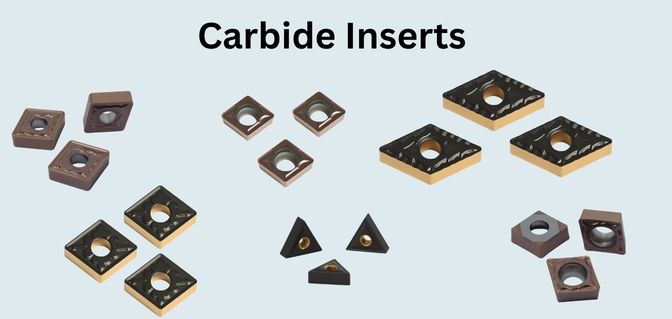
Carbide inserts are replaceable cutting tips generally made from cemented carbide, typically consisting of tungsten carbide particles and a metallic binder such as cobalt. They are mounted on CNC tool holders and used to remove material from a workpiece during machining operations.
Unlike traditional solid cutting tools, carbide inserts can be replaced after wear, reducing tooling costs and improving productivity. They are available in different shapes, grades, coatings, and geometries, each designed for a specific machining operation.
Choosing the right carbide insert depends on factors such as workpiece material, cutting speed, feed rate, depth of cut, and required surface finish.
How to Choose the Right Carbide Insert
Selecting the right carbide insert is essential for achieving high machining accuracy, longer tool life, and improved productivity. The correct insert depends on several machining factors, including the workpiece material, machining operation, cutting speed, and desired surface finish.
Consider the following factors when choosing a carbide insert:
1. Workpiece Material
Different materials require different insert grades and geometries.
- Steel – P Grade
- Stainless Steel – M Grade
- Cast Iron – K Grade
- Aluminium – N Grade or PCD Inserts
- Heat-Resistant Alloys – S Grade
- Hardened Steel – H Grade or CBN Inserts
2. Machining Operation
Choose the insert based on the type of machining:
- Rough Turning – Negative Turning Inserts
- Finishing – Positive Turning Inserts
- Milling – Milling Inserts
- Drilling – Drilling Inserts
- Threading – Threading Inserts (MMT)
- Parting & Grooving – Parting & Grooving Inserts
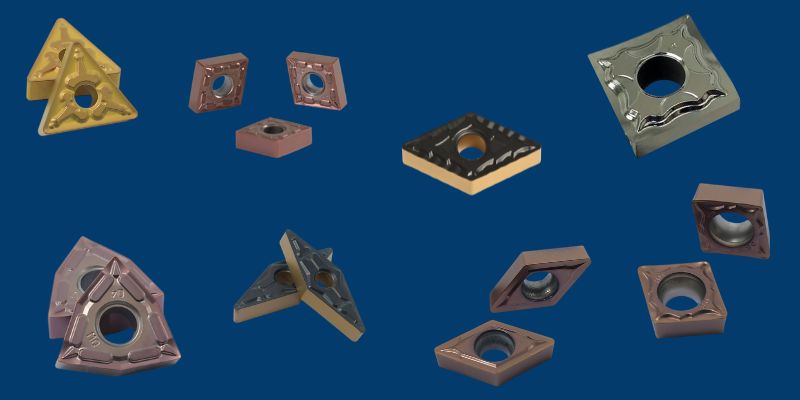
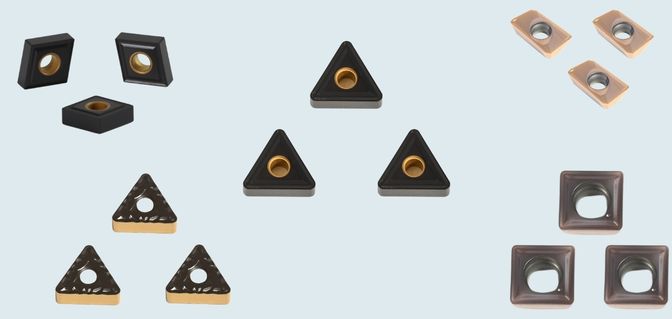
3. Insert Geometry
The insert shape affects chip control, cutting forces, and accessibility. Common shapes include:
- CNMG
- DNMG
- SNMG
- TNMG
- VNMG
- WNMG
4. Coating Type
Coated inserts generally provide better wear resistance and are suitable for high-speed machining, while uncoated inserts are often preferred for non-ferrous materials where a sharper cutting edge is beneficial.
5. Cutting Parameters
Always select an insert that matches your machine's cutting speed, feed rate, and depth of cut. Using the correct cutting parameters helps maximize insert life and maintain consistent machining quality.
Types of Carbide Inserts
Different types of carbide inserts are designed for specific CNC machining operations. Selecting the right insert improves machining accuracy, tool life, productivity, and surface finish.
1. Positive Turning Inserts
Positive Turning Inserts reduce cutting forces and provide a smooth surface finish. They are ideal for finishing and semi-finishing steel, stainless steel, aluminium, and other non-ferrous materials.
Key Benefits
- Lower cutting forces
- Better surface finish
- Reduced vibration
- Ideal for light machining
2. Negative Turning Inserts
Negative Turning Inserts feature a strong cutting edge with multiple usable corners, making them suitable for rough turning and heavy-duty machining applications.
Key Benefits
- Strong cutting edge
- Longer tool life
- Multiple cutting edges
- Cost-effective machining
3. Milling Inserts
Milling Inserts are used for face, shoulder, slot, and profile milling. They provide stable cutting performance, excellent chip control, and high material removal rates.
Key Benefits
- High material removal
- Stable machining
- Excellent chip control
- Ideal for CNC milling
4. Drilling Inserts
Drilling Inserts are designed for indexable drilling systems to produce accurate holes while improving productivity and reducing tooling costs.
Key Benefits
- Accurate hole making
- Easy replacement
- Longer tool life
- High drilling efficiency
5. Threading Inserts (MMT)
Threading Inserts produce accurate internal and external threads with consistent quality, making them suitable for precision CNC threading operations.
Key Benefits
- Precise thread profiles
- Consistent machining
- Long insert life
- Reduced machining time
6. Parting & Grooving Inserts
Parting & Grooving Inserts are used for cut-off and grooving operations, offering excellent chip evacuation and accurate groove dimensions.
Key Benefits
- Excellent chip control
- Accurate groove cutting
- Reduced material waste
- Longer tool life
7. PCD Inserts
PCD Inserts are ideal for machining aluminium, brass, copper, composites, and other non-ferrous materials where superior wear resistance and surface finish are required.
Key Benefits
- Exceptional wear resistance
- Excellent surface finish
- High-speed machining
- Long tool life
8. CBN Inserts
CBN Inserts are designed for machining hardened steel, cast iron, and other hard materials, providing excellent dimensional accuracy and wear resistance.
Key Benefits
- High hardness
- Superior wear resistance
- Precision machining
- Long cutting life
9. Aluminium Inserts (MDAL)
Aluminium Inserts (MDAL) feature sharp cutting edges that reduce built-up edge and improve chip flow for machining aluminium and other non-ferrous metals.
Key Benefits
- Smooth chip evacuation
- Excellent surface finish
- High machining speed
- Sharp cutting edge
10. Cermet Inserts (MDC)
Cermet Inserts (MDC) are suitable for finishing and semi-finishing steel and stainless steel, delivering excellent wear resistance and surface finish.
Key Benefits
- Superior surface finish
- High wear resistance
- Dimensional accuracy
- Longer tool life
Best Carbide Insert for Different Materials
| Material | Recommended Insert |
| Mild Steel | CNMG |
| Stainless Steel | CCMT |
| Cast Iron | SNMG |
| Aluminium | PCD / MDAL |
| Hardened Steel | CBN |
Common Carbide Insert Shapes
Common carbide insert shapes include:
- CNMG
- DNMG
- SNMG
- TNMG
- VNMG
- WNMG
- CCMT
- DCMT
- VCMT
The correct insert shape depends on the machining operation, cutting direction, workpiece geometry, required strength, and accessibility.
Comparison of Different Types of Carbide Inserts
| Insert Type | Primary Use | Best For |
| Positive Turning Inserts | Finishing & Semi-Finishing | Steel, Stainless Steel, Aluminium |
| Negative Turning Inserts | Rough Turning | Steel, Cast Iron, Alloy Steel |
| Milling Inserts | Face & Shoulder Milling | CNC Milling Machines |
| Drilling Inserts | Hole Making | Indexable Drilling |
| Threading Inserts | Internal & External Threads | Precision Threading |
| Parting & Grooving Inserts | Cut-Off & Grooving | CNC Turning |
| PCD Inserts | Non-Ferrous Materials | Aluminium, Brass, Copper |
| CBN Inserts | Hardened Materials | Hardened Steel, Cast Iron |
| Aluminium Inserts (MDAL) | Aluminium Machining | Non-Ferrous Metals |
| Cermet Inserts (MDC) | Finishing Operations | Steel & Stainless Steel |
Applications of Carbide Inserts
Different types of carbide inserts are used across a wide range of machining operations, including:
- External Turning
- Internal Turning
- Face Milling
- Shoulder Milling
- Slot Milling
- Hole Drilling
- Internal Threading
- External Threading
- Parting
- Grooving
- Finish Machining
- Rough Machining
- Semi-Finish Turning
- High-Speed CNC Machining
Industries That Use Carbide Inserts
Carbide inserts are essential in many industrial sectors, including:
- Automotive Industry
- Aerospace Industry
- CNC Machine Shops
- General Engineering
- Railway Industry
- Oil & Gas Industry
- Heavy Equipment Manufacturing
- Die & Mould Industry
- Medical Equipment Manufacturing
- Industrial Machinery Production
- Tool Rooms
- Precision Engineering
Materials That Can Be Machined
The correct carbide insert can machine a variety of engineering materials:
| Material | Suitable Insert |
| Mild Steel | Positive / Negative Turning Inserts |
| Carbon Steel | Negative Turning Inserts |
| Stainless Steel | Positive Turning / Cermet Inserts |
| Cast Iron | Negative Turning / CBN Inserts |
| Alloy Steel | Negative Turning Inserts |
| Hardened Steel | CBN Inserts |
| Aluminium | MDAL / PCD Inserts |
| Brass | PCD Inserts |
| Copper | PCD Inserts |
| Titanium | Special Carbide Grades |
Advantages of Using Carbide Inserts
Using the right Carbide Inserts offers several benefits:
- Longer tool life
- Higher machining productivity
- Excellent wear resistance
- Better dimensional accuracy
- Improved surface finish
- Reduced machine downtime
- Easy insert replacement
- Cost-effective machining
- High-speed cutting capability
- Consistent machining quality
Carbide Insert Grades Explained
Choosing the correct insert grade improves machining efficiency and tool life.
| Grade | Suitable Material | Typical Application |
| P Grade | Steel | General turning and milling |
| M Grade | Stainless Steel | Continuous and interrupted cutting |
| K Grade | Cast Iron | Roughing and finishing |
| N Grade | Aluminium & Non-Ferrous Metals | High-speed machining |
| S Grade | Heat-Resistant Alloys | Aerospace and high-temperature materials |
| H Grade | Hardened Steel | Hard turning and precision machining |
Frequently Asked Questions About Carbide Inserts
1. What are carbide inserts?
Carbide inserts are replaceable cutting tools made from tungsten carbide. They are used in CNC machining for turning, milling, drilling, threading, and grooving operations, providing high wear resistance and longer tool life.
2. What are the main types of carbide inserts?
The main types include Positive Turning Inserts, Negative Turning Inserts, Milling Inserts, Drilling Inserts, Threading Inserts (MMT), Parting & Grooving Inserts, PCD Inserts, CBN Inserts, Aluminium Inserts (MDAL), and Cermet Inserts (MDC).
3. Which carbide insert is best for steel?
P Grade carbide inserts are commonly used for machining mild steel, carbon steel, and alloy steel. The exact insert depends on the machining operation and cutting conditions.
4. Which insert is suitable for stainless steel?
M Grade carbide inserts and Cermet Inserts are often preferred for stainless steel because they provide good wear resistance and excellent surface finish.
5. What is the difference between positive and negative turning inserts?
Positive Turning Inserts require lower cutting forces and are ideal for finishing, while Negative Turning Inserts have stronger cutting edges and are better suited for roughing and heavy-duty machining.
6. What are PCD inserts used for?
PCD inserts are used for machining aluminium, brass, copper, composites, and other non-ferrous materials where excellent surface finish and long tool life are required.
7. What are CBN inserts used for?
CBN inserts are designed for machining hardened steel, cast iron, and heat-treated materials with high precision and excellent wear resistance.
8. Which carbide insert is best for aluminium?
Aluminium Inserts (MDAL) and PCD Inserts are commonly used because they reduce built-up edge and provide smooth chip flow.
9. How do I choose the right carbide insert?
Consider the workpiece material, machining operation, insert geometry, grade, coating, cutting speed, feed rate, and required surface finish.
10. Are coated inserts better than uncoated inserts?
Coated inserts generally offer better wear resistance and longer tool life for steel and stainless steel. Uncoated inserts are often preferred for non-ferrous materials.
11. What industries use carbide inserts?
Carbide inserts are widely used in automotive, aerospace, railway, oil & gas, precision engineering, die & mould, and general manufacturing industries.
12. How long do carbide inserts last?
Insert life depends on the material being machined, insert grade, cutting speed, feed rate, coolant usage, and machining conditions. Proper cutting parameters help maximize tool life.
13. Can carbide inserts be reused?
Most carbide inserts are indexable, meaning they can be rotated to use additional cutting edges until all edges are worn.
14. Why choose Metaldur for carbide inserts?
Metaldur supplies a wide range of quality carbide inserts with competitive pricing, ready stock, technical support, and reliable PAN India delivery for industrial customers.
15. Does Metaldur supply carbide inserts across India?
Yes. Metaldur supplies carbide inserts to engineering industries, CNC machine shops, dealers, distributors, and industrial buyers across India.
Conclusion
Understanding the types of carbide inserts helps you choose the right cutting tool for your machining application. From Positive Turning Inserts and Negative Turning Inserts to Milling Inserts, Drilling Inserts, Threading Inserts, PCD Inserts, and CBN Inserts, each insert type is designed to improve productivity, machining accuracy, and tool life. Selecting the correct insert grade, geometry, and coating ensures better cutting performance and lower production costs. As a trusted Carbide Inserts Supplier in India, Metaldur offers a comprehensive range of carbide inserts to meet the diverse needs of engineering industries and industrial buyers across India.
Contact Metaldur
Looking for reliable Carbide Inserts for your CNC machining operations?
Metaldur supplies a wide range of carbide inserts for turning, milling, drilling, threading, grooving, and precision machining applications. Whether you need technical assistance, bulk orders, or a product quotation, our team is ready to help.
Contact Metaldur today to discuss your requirements and find the right carbide insert solution for your business.