On this page
- What Are PCD Inserts?
- PCD Insert Full Form and Working Principle
- PCD Insert Types
- PCD Insert for Aluminium
- What Are CBN Inserts?
- CBN Insert Full Form
- PCBN Inserts
- What Are Cermet Inserts?
- Cermet vs Ceramic Insert
- PCD vs CBN vs Cermet Inserts: Key Differences
- PCD Inserts vs CBN Inserts
- CBN Inserts vs Cermet Inserts
- PCD vs Cermet Inserts
- When Should You Choose PCD Inserts?
- When Should You Choose CBN Inserts?
- When Should You Choose Cermet Inserts?
- PCD Insert Price: What Affects the Cost?
- Choosing a PCD Insert Supplier
- CBN Insert Price, Catalogue and Selection
- CBN Insert Price
- CBN Insert Supplier in India
- Cermet Insert Price and Buying Factors
- Selecting a Cermet Insert Supplier
- Non-Ferrous Inserts and Carbide Alternatives
- How to Select the Right Insert for Your Application
- 1. Identify the Workpiece Material
- 2. Check Material Hardness
- 3. Define the Machining Operation
- 4. Check Cutting Parameters
- 5. Select the Correct Geometry
- 6. Compare Total Machining Cost
- PCD vs CBN vs Cermet: Which Insert Is Best?
- Frequently Asked Questions
- What is the difference between PCD and CBN inserts?
- Are PCD inserts suitable for aluminium?
- Are CBN inserts suitable for hardened steel?
- What is better for aluminium, PCD or CBN?
- What is better for hardened steel?
- Are Cermet inserts suitable for finishing?
- Are PCD inserts expensive?
- How do I select between PCD, CBN and Cermet?
Choosing the right cutting insert can directly affect machining accuracy, tool life, surface finish and overall production cost. PCD, CBN and Cermet inserts are designed for different machining conditions, materials and applications. Selecting the correct grade and insert geometry depends on the workpiece material, cutting speed, required finish and machining operation.
This guide explains the differences between PCD, CBN and Cermet cutting inserts, their applications, advantages, limitations, pricing factors and how to select the right option for industrial machining.
Whether you are machining aluminium, copper, cast iron, hardened steel or other engineering materials, understanding these insert technologies can help you choose a suitable cutting solution.
What Are PCD Inserts?
PCD stands for Polycrystalline Diamond. PCD cutting inserts are manufactured using diamond particles bonded together with a suitable binder and joined to a carbide substrate.
Diamond provides extremely high hardness and excellent resistance to abrasive wear. Because of these properties, PCD tooling is widely used for high-speed machining of non-ferrous materials and abrasive non-metallic materials.
PCD Insert Full Form and Working Principle
The full form of PCD insert is Polycrystalline Diamond Insert. Unlike conventional carbide tooling, the cutting edge contains a polycrystalline diamond layer that provides excellent wear resistance.
PCD is particularly useful when manufacturers need:
- Long tool life
- High cutting speeds
- Excellent surface finish
- Consistent dimensional accuracy
- Reduced tool changes
- High productivity in repetitive machining
PCD Insert Types
There are several PCD insert types available according to insert geometry, cutting application, diamond grade, and workpiece material.
Common applications include:
- Aluminium machining
- Copper machining
- Brass machining
- Composite materials
- Graphite
- Wood-based materials
- Non-ferrous automotive components
- Aerospace components
The correct geometry should be selected according to the machining operation and component design.
PCD Insert for Aluminium
A PCD insert aluminum application is particularly common because aluminium can be machined at high cutting speeds and often requires a sharp cutting edge to achieve a good surface finish.
PCD tooling can be suitable for:
- Aluminium engine components
- Automotive parts
- Aluminium housings
- Wheels
- Cylinder heads
- High-speed milling operations
For aluminium and other non-ferrous materials, the insert geometry, rake angle and edge preparation should be considered before selection.
What Are CBN Inserts?
CBN stands for Cubic Boron Nitride. CBN is an extremely hard cutting material and is particularly suitable for machining hard ferrous materials.
CBN tooling is commonly associated with hard turning, hardened steel machining and cast iron applications.
CBN Insert Full Form
The CBN insert full form is Cubic Boron Nitride insert. CBN offers high hardness and thermal stability, making it useful in demanding machining operations where conventional carbide tooling may have limited tool life.
Typical applications include:
- Hardened steel
- Bearing steel
- Tool steel
- Alloy steel
- Cast iron
- Hardened automotive components
- Brake components
- Gears
- Shafts
PCBN Inserts
PCBN inserts are made using polycrystalline cubic boron nitride technology. PCBN cutting edges can provide excellent wear resistance and stable performance during hard machining.
They are particularly useful when manufacturers need to machine hardened components while maintaining dimensional accuracy and surface quality.
For some hard-turning applications, PCBN tooling can also reduce the need for additional grinding operations.
What Are Cermet Inserts?
Cermet is a composite cutting material combining ceramic and metallic components. Cermet tooling is commonly used for finishing and semi-finishing applications where surface quality, edge stability and wear resistance are important.
Cermet inserts can be suitable for machining steels and selected engineering materials at appropriate cutting conditions.
Cermet vs Ceramic Insert
Although both technologies use ceramic-based cutting materials, Cermet and ceramic inserts are not identical.
Cermet generally combines ceramic particles with a metallic binder, while ceramic cutting materials are primarily based on ceramic compounds.
The choice depends on:
- Workpiece material
- Cutting speed
- Interrupted or continuous cutting
- Required surface finish
- Tool life expectations
- Machine stability
A Ceramic insert may be preferred for certain high-temperature machining applications, while Cermet can be advantageous for specific finishing operations.
PCD vs CBN vs Cermet Inserts: Key Differences
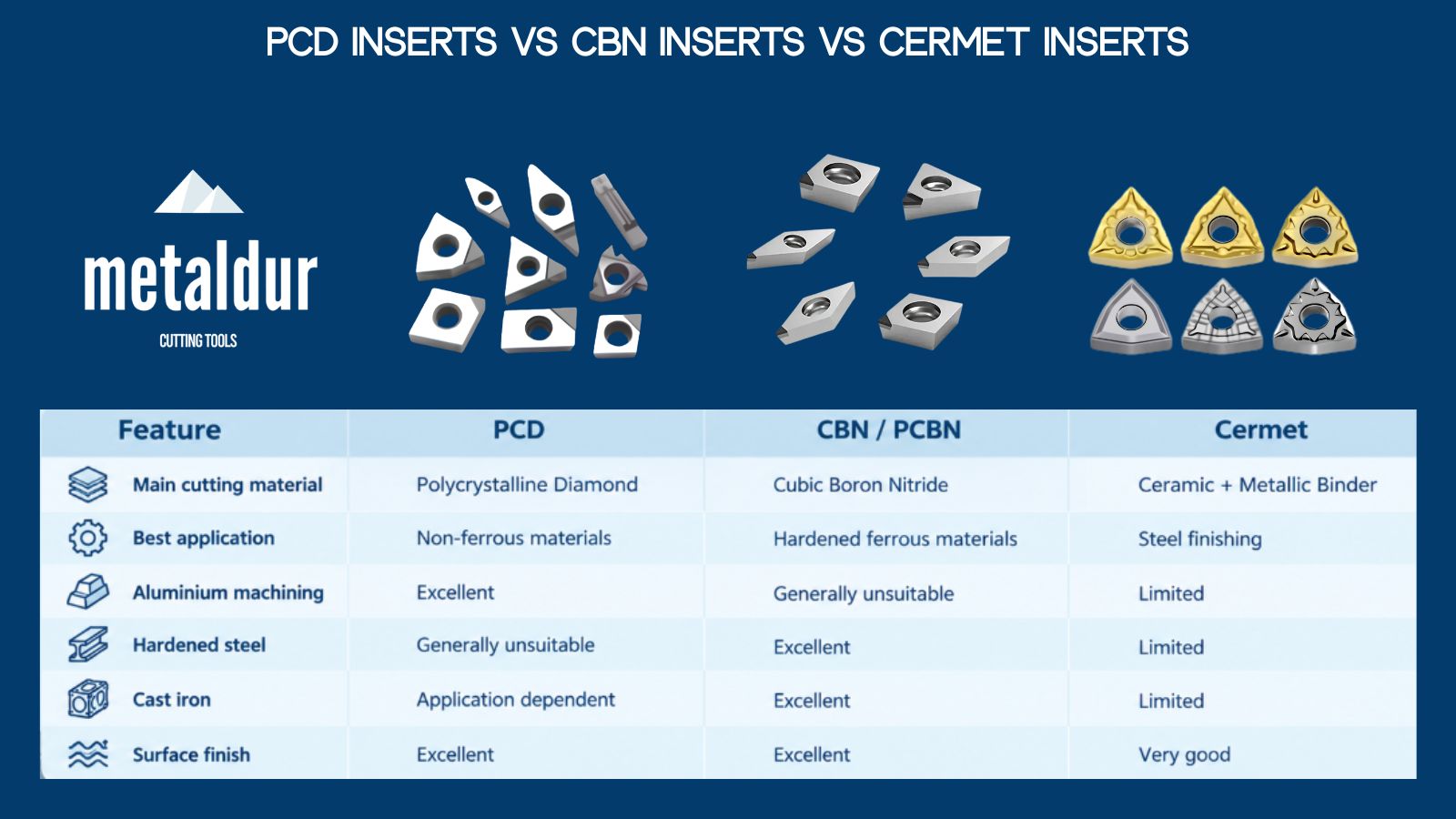
PCD, CBN and Cermet should not be treated as interchangeable cutting tools. Each technology has a different area of application.
| Feature | PCD | CBN / PCBN | Cermet |
| Main cutting material | Polycrystalline Diamond | Cubic Boron Nitride | Ceramic + Metallic Binder |
| Best application | Non-ferrous materials | Hardened ferrous materials | Steel finishing |
| Aluminium machining | Excellent | Generally unsuitable | Limited |
| Hardened steel | Generally unsuitable | Excellent | Limited |
| Cast iron | Application dependent | Excellent | Limited |
| Surface finish | Excellent | Excellent | Very good |
| Abrasion resistance | Very high | Very high | High |
| Typical machining | High-speed non-ferrous machining | Hard turning | Finishing and semi-finishing |
| Relative cost | High | High | Moderate to high |
PCD Inserts vs CBN Inserts
The main difference between PCD and CBN is the type of material they are designed to machine.
PCD is particularly suitable for aluminium, copper, brass, composites and other abrasive non-ferrous materials. CBN is mainly selected for hardened steels, cast iron and other ferrous applications.
Using PCD on unsuitable ferrous materials can cause rapid chemical wear because diamond has limitations at elevated temperatures when machining iron-based materials.
CBN is therefore generally the more appropriate option for hard turning applications.
CBN Inserts vs Cermet Inserts
CBN and Cermet can both be used in finishing applications, but their performance range is different.
CBN is particularly valuable when machining hardened steel and other demanding ferrous materials. Cermet is often selected for stable finishing operations where good surface quality and predictable tool life are required.
The final selection should consider hardness, cutting speed, depth of cut, feed rate and whether the operation is continuous or interrupted.
PCD vs Cermet Inserts
PCD is generally used for non-ferrous and abrasive materials, while Cermet is more commonly used for selected steel finishing operations.
For aluminium components that require high productivity and an excellent surface finish, PCD can be a strong option. For suitable steel finishing operations, Cermet may offer a practical balance between performance and tooling cost.
When Should You Choose PCD Inserts?
PCD is worth considering when:
- The component is made from aluminium or another non-ferrous material.
- High cutting speeds are required.
- Long tool life is important.
- Excellent surface finish is required.
- The workpiece contains abrasive particles.
- Production volumes justify a higher-performance cutting edge.
The correct diamond grade and geometry should always be matched to the material and operation.
When Should You Choose CBN Inserts?
CBN is a strong choice for applications involving:
- Hardened steel
- Bearing components
- Hardened gears
- Cast iron
- Alloy steel
- Hard turning
- Precision finishing
It is especially useful when machining hardness levels where conventional carbide tools may experience rapid wear.
When Should You Choose Cermet Inserts?
Cermet can be considered when your application requires:
- Good surface finish
- Stable finishing performance
- Consistent dimensional control
- Suitable steel machining
- High-speed finishing
- A balance between tool life and tooling cost
Machine rigidity and workpiece stability should also be considered before selecting the insert.
PCD Insert Price: What Affects the Cost?
The Pcd inserts price can vary significantly depending on the diamond grade, insert shape, diamond layer, substrate, geometry and application.
Factors affecting the final cost include:
- PCD grade
- Diamond concentration
- Insert geometry
- Cutting-edge preparation
- Substrate material
- Insert size
- Application requirements
- Quantity ordered
Instead of comparing only the initial purchase price, industrial buyers should also consider tool life and the cost per component.
Choosing a PCD Insert Supplier
When selecting a Pcd inserts supplier, buyers should check product availability, insert specifications, grades, geometry options, application support and consistency of supply.
For production environments, dependable supply can be just as important as the initial insert price.
CBN Insert Price, Catalogue and Selection
The Cbn inserts price list can differ according to CBN content, grade, geometry, substrate and application.
Buyers comparing a Cbn inserts pdf should verify whether the document contains current specifications, available geometries, grades and application recommendations.
A proper Cbn inserts catalogue pdf can make it easier for purchasing and production teams to compare different options before placing an order.
A complete Cbn inserts catalogue may include:
- Insert shapes
- ISO designations
- Grades
- Nose radius
- CBN content
- Recommended materials
- Cutting parameters
- Application areas
CBN Insert Price
The CBN Insert Price should be evaluated together with expected tool life and machining productivity. A higher-priced insert can sometimes provide a lower cost per component if it delivers longer and more consistent tool life.
CBN Insert Supplier in India
For buyers searching for a CBN Insert supplier in India, it is important to evaluate availability, product range, technical specifications, delivery capability and support for industrial applications.
Cermet Insert Price and Buying Factors
The Cermet inserts price depends on grade, geometry, substrate, coating and insert dimensions.
A Cermet inserts price list can help purchasing teams compare different grades and geometries, but the lowest purchase price does not always represent the lowest machining cost.
Selecting a Cermet Insert Supplier
A reliable Cermet inserts supplier should be able to provide appropriate grades and geometries according to the machining application.
Before purchasing, check:
- Workpiece material
- Hardness
- Cutting speed
- Feed rate
- Depth of cut
- Insert geometry
- Nose radius
- Required surface finish
Non-Ferrous Inserts and Carbide Alternatives
Non-ferrous inserts are designed for materials such as aluminium, copper, brass and other non-ferrous alloys. PCD is often considered when high productivity, wear resistance and surface finish are required.
However, PCD is not the only cutting-tool solution. Carbide Inserts remain widely used because they offer versatility across many machining applications and are available in a broad range of grades and geometries.
The best choice depends on the material, machine capability, cutting conditions and production requirements.
How to Select the Right Insert for Your Application
Before selecting PCD, CBN or Cermet, follow these steps:
1. Identify the Workpiece Material
Determine whether you are machining aluminium, copper, hardened steel, cast iron, alloy steel or another engineering material.
2. Check Material Hardness
Hardness is particularly important when choosing tooling for hard turning applications.
3. Define the Machining Operation
Consider whether you are performing:
- Roughing
- Semi-finishing
- Finishing
- Turning
- Milling
- Grooving
- Profiling
4. Check Cutting Parameters
Review:
- Cutting speed
- Feed rate
- Depth of cut
- Coolant requirements
- Machine rigidity
5. Select the Correct Geometry
Insert shape, clearance angle, nose radius, and edge preparation can significantly influence performance.
6. Compare Total Machining Cost
Don't compare inserts only by purchase price. Consider tool life, tool changes, cycle time, scrap rate and surface-finish requirements.
PCD vs CBN vs Cermet: Which Insert Is Best?
There is no single insert material that is best for every machining application.
Choose PCD when high-speed machining of aluminium, copper, composites and other suitable non-ferrous materials is the priority.
Choose CBN or PCBN when machining hardened steel, cast iron and other suitable hard ferrous materials.
Choose Cermet when stable finishing and good surface quality are required for suitable steel applications.
The right decision depends on the workpiece material, hardness, machining operation, cutting parameters and production requirements.
Frequently Asked Questions
What is the difference between PCD and CBN inserts?
PCD is primarily used for non-ferrous and abrasive materials, while CBN is mainly used for hardened ferrous materials such as hardened steel and cast iron.
Are PCD inserts suitable for aluminium?
Yes. PCD is widely considered for high-speed aluminium machining because of its high wear resistance and ability to produce excellent surface finishes.
Are CBN inserts suitable for hardened steel?
Yes. CBN and PCBN tooling are commonly used for hard turning applications involving hardened steel and other suitable ferrous materials.
What is better for aluminium, PCD or CBN?
For most high-speed aluminium machining applications, PCD is generally the more appropriate choice because diamond performs particularly well on non-ferrous materials.
What is better for hardened steel?
CBN or PCBN is generally the preferred technology for suitable hardened-steel machining applications.
Are Cermet inserts suitable for finishing?
Yes. Cermet can be suitable for finishing and semi-finishing operations where surface quality, dimensional control and stable cutting performance are required.
Are PCD inserts expensive?
PCD inserts can have a higher initial purchase cost than conventional carbide tooling. However, their longer tool life and productivity can make them economical for suitable high-volume applications.
How do I select between PCD, CBN and Cermet?
Start with the workpiece material and hardness, then consider the machining operation, cutting parameters, required surface finish, machine rigidity and expected tool life.
PCD, CBN, and Cermet inserts each have a specific role in modern machining. PCD is strongly associated with high-speed non-ferrous machining, CBN is ideal for many hard-machining applications, and Cermet provides a practical solution for selected finishing operations.
Choosing the correct insert is not simply about selecting the hardest cutting material. The best result comes from matching the insert grade, geometry, and cutting conditions to the workpiece and machining operation.
For industrial buyers, comparing tool life, productivity, surface finish and total cost per component is often more useful than comparing the initial insert price alone.
If you are looking for the right insert for your machining application, review the available grades, geometries, and specifications and select the option according to your actual production requirements.
Looking for the right PCD, CBN, or Cermet insert for your machining application? Contact your cutting-tool supplier with your workpiece material, machine type, operation, and required insert specification to get the most suitable option for your production needs.